

Nina Rivera:
on Joy
Lands
Philippines & UK
‘Joy is both the shield that keeps hostility outside of our circle and the source of our openness.’
- Nat Raja, Mijke Van der Drift. Trans Femme Futures
Centric Lab proposed the following prompts on joy and healing to Nina Rivera, a long standing community organiser and advocate for the health justice of Trans racialised migrants and refugees.
How would you define joy?
What is the relationship between joy and the body/mind/spirit?
What is the role joy has played in your work and community?
How would you relate joy to mental injury?
How would you relate joy to healing or a tool for healing?
What is the role of joy in facing precarity and constant loss?
...On Joy is Nina’s response to these prompts through her experience, reflection, and imagination.
Joy lives in all of us. It is an ontological part of our humanity. Our bodies register it when stress levels are down, when cortisol and adrenaline are at their minimum and when endorphins and dopamine among many others spike, facilitated by numerous and varying factors and interventions that many of us have unimaginatively limited to financial success, romantic relationships and capitalist excess.
But more than hormones, Joy in its expression is complex. We all have unique and individual ways of registering and showing up for it. Over time, however, divisive rhetoric and ideologies, imaginations that suppress our creativity and ontologies that try to exclude some and centre a few, have pushed it further and further down into our deepest psyches, buried under the rubble of discontent, hatred and hopelessness. In a world run and overcome with duress, it has increasingly been difficult to access. We have forgotten not only what it means but more importantly what it is. In a world where our worth is measured by how much we produce and consume, the challenge is for us to now redefine and reimagine it for ourselves, for our own survival and that of future generations.
In its multiplicity, Joy can facilitate contention with oppressive systems, abandonment of pain and harm, rejection of hegemony, or all of these together at once. Many things can be true at any given time. Joy however has to be cultivated. It comes with preconditions of trust and safety. It is not an interim nor a consolation. It is a skill, inherent, but one that doesn’t come easily. It has to be coaxed out of the woods with calm clarity and earnest invitation. It is a skill we can learn to access whenever we confront harm imposed by Supremacist ideologies that buoy the State, and learn to harness it by its constant, conscious practice in our communities. It is interested in innovative ways of world-building — in forming cooperatives, organising collectives, seeding initiatives. In these practices we build fresh infrastructures that make us less reliant on the State and its attendant institutions; we rehearse the fall of empire and oppressive hegemonies, ‘lay siege to it, deprive it of oxygen’ (Arundhati Roy. War talk). Joy is the geometry on which these new worlds outside of Supremacist epistemologies are arranged.
In its simplicity, Joy is a portal and a permission. It is a portal to the myriad ways that healing manifests, a permission to heal. When Trans migrants come together for a karaoke session for instance, to sing only songs in their mother tongues, or when women of Chiapas organise to create their own health clinics for the Indigenous demographic, they do not find mere social interventions. These are deliberate attempts to deliquesce the rigidity of discipline that the West tries to incessantly impose on our bodies.
These are responses to a world in orchestrated chaos, invocations to more-than-human Kin. When duress brought about by the destruction of our ecologies, dispossession of our rights and the forced manufacture of poverty, hunger, displacement and wars begins to overwhelm, we find ways to overcome — by Joy alchemising this duress into creativity that greases the flourishing of our communities. The karaoke and the clinics are examples of what comes when duress is transformed.
In the Indigenous health clinics of Chiapas the women are not only addressing pathologies among the Indigenous population, they are not only practising care within and among the community, they are also and perhaps more importantly, reanimating Indigenous knowledges that have long suffered from various and continuous attempts at erasure. Rooted in these knowledges and in the company of other community members whose lived experiences they share, trust and safety are established. Joy is birthed in the freedom from pathologisation, and paves the way for Wellness to be reimagined as a healing journey, a ’fortification of the heart’.
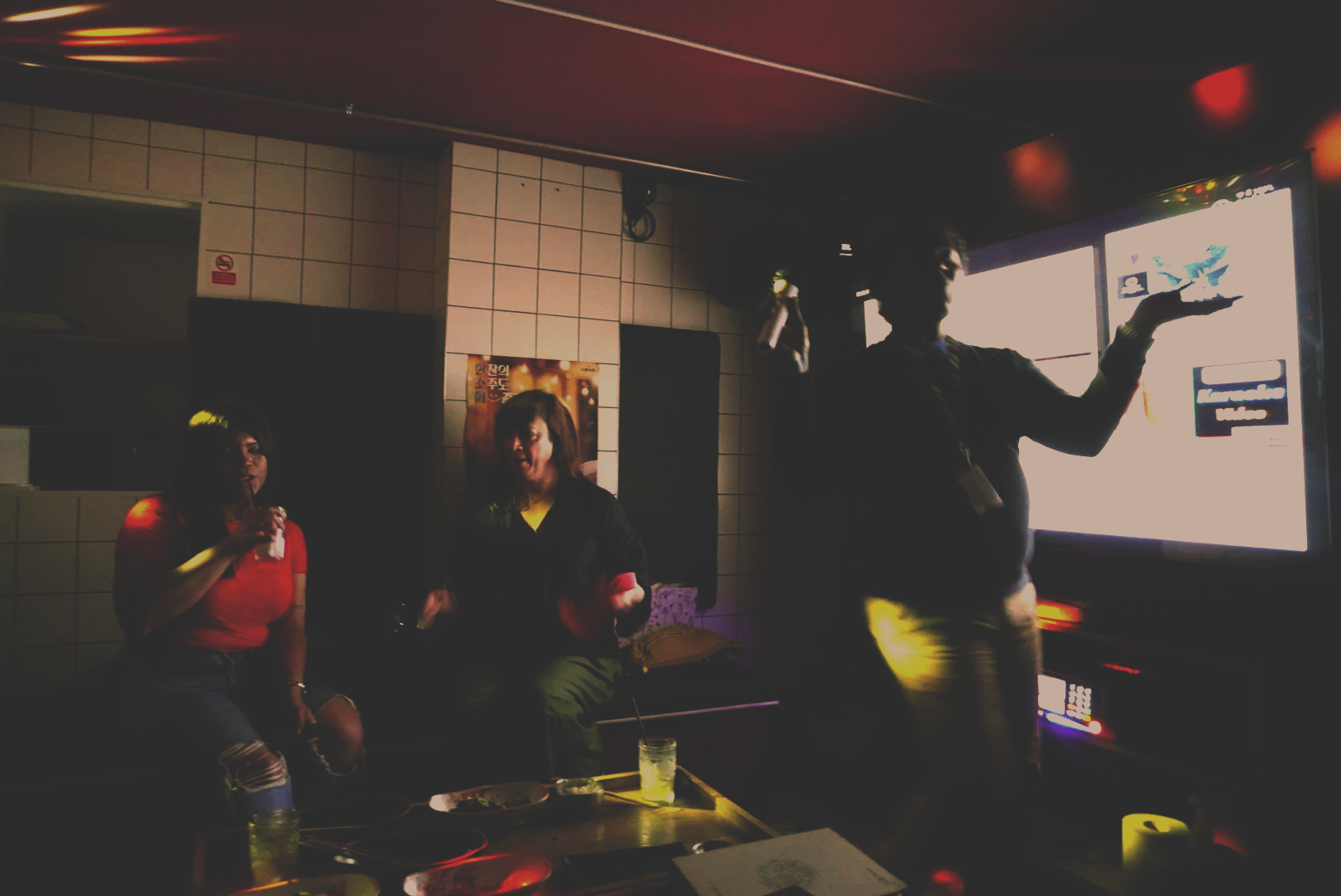
While karaoke is often seen superficially as a ‘fun activity’, when Trans migrants use their embodied voices in karaoke, they are not merely ‘enjoying themselves’. Their shared experiences of systemic harm and oppression is the ground on which the seeds of trust and safety are incubated.
In this incubation, they grieve and celebrate simultaneously, expunging duress from their systems. Grieving all that they have lost from existing in and surviving precarity, and celebrating hope and possibility. And through this process of nurturing, they then force Joy forth into the world. It is never accidental, it’s always deliberate. They are not ‘just singing’, they are singing the new world they dream of, into existence. The songs may come from disparate parts of the world, but in their translocalisation, experiences are altered and realities are recreated anew.
When Joy is conjured, the walls of defence come down, often unconsciously and inconspicuously. And the moment the armours are put aside, a space is cleared, spirits open up. It is this space that offers an opportunity for healing to come in and occupy, welcoming all that is good and protective, antidotes to a world of aggravation. Joy expands our capacities for healing. By instinctively protecting our bodies from what it recognises as violence, divesting them of the rubble that harm leaves, it lets our internal architectures swell with exuberance, allowing space for renewal and regeneration and consequently strengthening our ability to dream. Trust and safety birth Joy. Joy transforms duress into creativity. Creativity generates innovative healing imaginations.
In our intimate conversations, in the complacency of our relationships, in the conditionality of our shared spaces, one will find Joy actively transforming and quietly metabolising harm into healing. It may not be obvious and in its seeming inconsequentiality it may often be taken for granted, exploited even, but in its profound essence, it is a most tender path to imagining new ways to heal.